AI-Augmented ‘Opinionism’ • Founder's Notebook • Data-Driven • AI-Assisted • Human-Guided
Splitting an Album Across Four Apps Isn't 'Competition'
A techie and football fan's look at how exclusive TV rights turned UK football into stacked mini-monopolies, why paying £75+ a month still leaves a third of the Premier League blacked out, and why fans overseas get all 380 games in one place.
Rob Ross - Founder • Originally published • 11 min read • 2391 words
Editorial Point-in-Time Snapshot: Figures cited in essay prose reflect Touchline Wire telemetry on the publication date above; follow the live data links below for real-time updates.
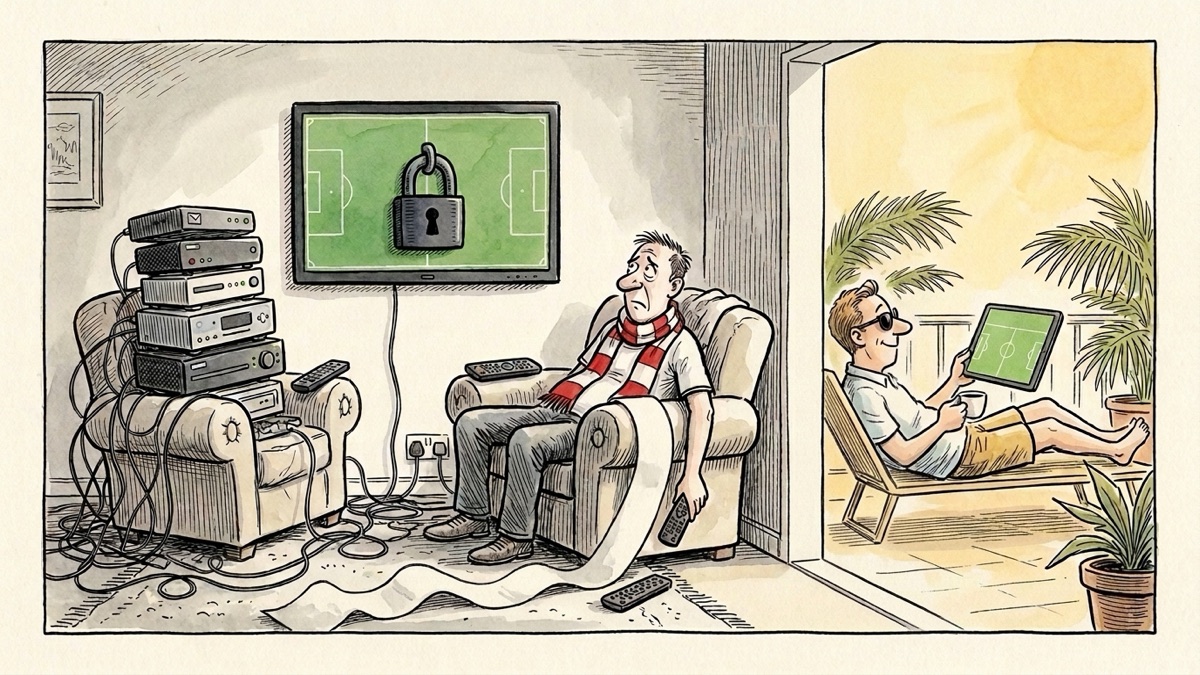
Imagine opening Spotify on a Saturday afternoon to listen to your favourite band's new twelve-track album, only to discover that tracks one to six are exclusive to Spotify at £34.99 a month, tracks seven and eight require an Apple Music subscription at £30.99 a month, and track nine sits locked behind Amazon Prime for another £8.99.
Then imagine reading the small print on tracks ten, eleven, and twelve and finding out they are legally banned from playing anywhere in Britain at three o'clock because a group of record-shop owners lobbied Parliament in the 1960s. Meanwhile, a mate living in Toronto or Sydney opens a single app, pays about fifteen pounds a month, and streams all twelve tracks in crystal-clear 4K without leaving the sofa.
No music fan on earth would call that setup "healthy competition," yet that is the exact market British football supporters live inside during the 2026/27 season. Even worse, from August 2027 - when Paramount+ takes over the main UK Champions League package - following an English club across domestic and European football will require four separate paid subscriptions.
Real Competition vs. Stacked Mini-Monopolies
I work in software and product design, and in almost every normal consumer market, competition means two or more companies selling access to the same product so you pick one winner.
Spotify and Apple Music carry essentially the same music catalogue, so you choose whichever app has the better audio quality, interface, or monthly price. Supermarkets stock the same tins of beans, and fibre broadband providers sell access over the same street cabinets, forcing them to compete for your custom rather than holding half the street to ransom.
UK football broadcasting broke away from that logic two decades ago. Ahead of the 2007/08 season, the European Commission intervened to end BSkyB's fourteen-year live Premier League monopoly, intending to lower prices and widen consumer choice (The Independent - EC ruling ends Sky's monopoly).
Instead of forcing non-exclusive wholesale licensing so rival broadcasters could compete head-to-head on the same matches, regulators carved the season into mutually exclusive packages. Every rights auction since has quietly baked that design flaw deeper into British sport.
When one company holds Saturday 12:30pm and another holds Saturday 5:30pm, you do not have two rivals competing for your subscription. You have two complementary mini-monopolies selling different halves of a season you cannot mix and match.
A supporter cannot boycott TNT Sports over price and watch Manchester City against Fulham's Saturday lunchtime kick-off on Sky instead, because those ninety minutes exist in only one place. Nor can an angry subscriber punish a poor app experience when a platform like NOW still charges £6 to £9 extra every month in "Boost" add-ons just to unlock 1080p or 4K HDR on top of a £34.99 sports pass.
Every time a new broadcaster enters the auction - Setanta, ESPN, BT and TNT Sports, Amazon Prime, and soon Paramount+ - the league celebrates a bigger rights cheque while the customer simply gets handed another tollbooth.
The Receipts: Paying the Most on Earth to Legally Watch the Least
Look at what it actually costs a supporter in Britain to watch Premier League and European football legally in 2026/27 compared with major broadcast markets overseas:
| Market & Broadcaster Setup | Retail Cost (Approx. Monthly / Annual) | Live PL Games Shown | Saturday 3pm Included? | Verified Source |
|---|---|---|---|---|
| UK (2026/27 Season): NOW / Sky Sports + TNT Sports + Amazon Prime Video | ~£75/mo flexible (£34.99 NOW + £30.99 TNT + £8.99 Prime), or £81–£84/mo with 1080p/4K Boost (£800–£1,000/yr) | ~270 / 380 (~71%) under the £6.7bn 2025–2029 cycle (Amazon exited domestic PL) | No (~110 games blacked out across all UK screens) | Premier League - £6.7bn UK broadcast deal · Amazon UK - Prime Tuesday UCL renewal |
| UK (From 2027/28): Sky Sports + TNT Sports + Paramount+ + Amazon Prime Video | 4 separate paid apps (£83–£95+/mo) for supporters of English Champions League clubs | Still ~270 / 380 (~71%); Paramount+ takes main UCL, Sky wins UEL/UECL, TNT keeps 52 PL + FA Cup | No (~110 games still blacked out) | The Guardian - Paramount+ wins UK Champions League rights · SportsPro - 2027–2031 UK UEFA rights |
| Canada (Fubo): Single exclusive streaming home | 1 app (~CA$231–CA$294/yr promo-to-standard / ~£135–£180/yr, roughly £12–£15/mo) | 380 / 380 (100%) live, including 4K streams | Yes | TechRadar - Global Premier League streaming comparison |
| Australia (Stan + Stan Sport): Single football add-on ecosystem | 1 ecosystem (~AU$360/yr combined base + sport add-on / ~£180/yr) | 380 / 380 (100%) live, ad-free, and on demand | Yes | TechRadar - Global Premier League streaming comparison |
| United States (NBC Sports: Peacock + USA Network) | ~£25–£35/mo (~£300–£350/yr across Peacock + live cable bundle) | 380 / 380 (100%) live | Yes | TechRadar - Global Premier League streaming comparison |
| India (JioHotstar) & Sub-Saharan Africa (Showmax PL Plan) | 1 app (~£9/yr in India; ~£4–£8/mo mobile plan in Africa) | 380 / 380 (100%) live in one official app | Yes | TechRadar - Global Premier League streaming comparison |
To be completely fair, comparing London prices directly against Mumbai or Lagos misses local purchasing power, because global streamers always price emerging markets around local wages.
The real indictment sits in Canada, Australia, and the United States. Those are wealthy, high-wage Western economies with comparable living costs to Britain, yet supporters there pay between a quarter and half of a British fan's annual bill - and in exchange, they receive 100 per cent of England's own domestic league in one place.
Only in the country where the football is actually played do households pay the highest subscription bills on earth for roughly 71 per cent of the season.
Bob Lord's 1960s Ghost: Why Saturday 3pm Is Still Illegal on UK Screens
Ask why nearly a third of the Premier League still vanishes from British television every weekend and you run straight into a ghost from 1960s Lancashire.
Between 14:45 and 17:15 on Saturday afternoons, UK broadcasters are barred from showing any live football under UEFA Article 48, a closed-period regulation that Britain is now the only major European football nation still enforcing (Economics Observatory - Should the Saturday 3pm blackout be lifted?).
The rule dates back to former Burnley chairman Bob Lord, who famously banned Match of the Day cameras from Turf Moor for five years after the programme launched in 1964 and persuaded fellow Football League chairmen that live television would empty Saturday afternoon turnstiles.
In 1964, when almost every club relied on cash at the gate and empty terraces were common, that fear made intuitive sense. In November 2026, it borders on farce.
Premier League stadiums routinely run at 98 to 100 per cent capacity behind multi-year season-ticket waiting lists and digital membership ballots. A supporter sitting in Birmingham, Liverpool, or North London whose team kicks off at 3pm on Saturday cannot decide at 2:30pm to wander down to Villa Park, Anfield, or the Emirates and pay at the gate - those seats sold out weeks ago.
Article 48 even produces bureaucratic absurdities nobody could defend with a straight face, such as UK rightsholders being forced to delay joining a 17:00 UK Spanish or Italian match for fifteen minutes until 17:15 because the final quarter-hour of Britain's blackout window has not ticked down.
Still, lower-league clubs deserve a respectful hearing whenever this rule comes up (The Guardian - Premier League & EFL talks on Saturday 3pm blackout). Grassroots, National League, and League One and Two clubs are the lifeblood of English football, and no serious reform should leave them exposed.
Yet the modern reality already undercuts the blackout's central claim. Sky Sports+ now broadcasts over 1,000 EFL fixtures live across weekend slots every season, including early Saturday games, and independent economic research has repeatedly struggled to prove that televising Premier League matches stops loyal supporters attending their local ground.
If the football authorities genuinely want to protect the pyramid, statutory solidarity payments funded directly by 3pm streaming revenues would put far more guaranteed cash into lower-league coffers than pretending fans will walk down to a fourth-tier turnstile simply because Sky switched the screen off.
What Our 2026/27 UK Broadcast Data Shows Club by Club
When we built the UK Football TV & 3pm Blackout Guide (also at Football on TV) on Touchline Wire, I wanted to see the exact impact of this split-rights system across an entire club calendar rather than relying on vague complaints.
Our early-November 2026 snapshot of 500 scheduled fixtures across the Premier League (280), UEFA club competitions (198), and the UEFA Nations League (22) shows 394 matches selected for live UK broadcast, 106 locked behind the Saturday 3pm blackout, and just 22 free-to-air broadcasts - all Nations League ties, with zero club fixtures free-to-air.
If you support a club competing in the Champions League, you have no choice but to pay for every single paywall at once:
- Arsenal (Arsenal TV Guide): Across 32 upcoming games in our tracker, 19 air on Sky Sports, 3 on TNT Sports, and 1 on Amazon Prime Video - leaving 9 Saturday 3pm blackouts on radio only.
- Liverpool (Liverpool TV Guide): 17 on Sky Sports, 4 on TNT Sports, 1 on Prime Video, and 10 blacked out at 3pm.
- Manchester City: 18 on Sky Sports, 3 on TNT Sports, 2 on Prime Video, and 9 blacked out at 3pm.
- Aston Villa (Aston Villa TV Guide): 17 on Sky Sports, 3 on TNT Sports, 2 on Prime Video, and 10 matches shut out by the Saturday 3pm ban - starting straight after this international break when Villa host Sunderland at 3pm on Saturday 21 November.
Switch down to the newly promoted and non-Champions League clubs and the penalty shifts from paying across three apps to paying a fortune to miss nearly half your own team's league matches:
- Coventry City (Coventry City TV Guide), Ipswich Town, and Leeds United each have 13 of their 28 remaining league matches (46 per cent) blocked by the Saturday 3pm blackout.
- Bournemouth, Brentford, and Fulham sit right behind them on 12 blackouts apiece, while Hull City and Sunderland lose 11 matches each to radio-only afternoons (despite Bournemouth, Sunderland, and Crystal Palace playing Thursday nights in the Europa League).
Think about that from the perspective of a loyal Coventry, Ipswich, or Hull supporter who finally watched their club earn promotion back to the top flight (FSA - Supporter campaign on rising football costs). You pay Sky every month, rarely feature in Champions League midweek slots, and still legally miss almost every other league match your team plays.
That weekly guesswork - "is this one on Sky, Sky Sports+, TNT, Prime, or blocked until 5:15pm?" - is precisely why we added club-filtered TV guides across UK TV Schedule and Season Fixtures, so pinning My Club gives supporters an instant answer without digging through four apps.
Gabe Newell's Rule: Piracy Is a Service Problem, Not Just a Price Problem
Back in 2011, Valve co-founder Gabe Newell offered a line that every media executive in Britain ought to frame on their wall: "Piracy is almost always a service problem and not a pricing problem."
In the early 2000s, record labels and software companies spent fortunes chasing Napster and BitTorrent users through the courts while making legal ownership slow, fragmented, and painful. Piracy did not collapse because police knocked down bedroom doors; it collapsed the moment Spotify and Steam put the entire catalogue inside one clean, reliable product at a fair monthly or seasonal price.
People are overwhelmingly happy to pay when the legal option is easier than hunting for a flaky stream.
Instead of learning that lesson, UK football authorities pour millions into dynamic High Court IP blocks while designing a legal customer journey that actively punishes the people willing to pay. Asking working households to juggle £800 to £1,000 a year across three apps - soon to be four when Paramount+ enters the Champions League fold in 2027 - while still failing to show roughly 110 Premier League matches is a textbook UX failure.
When a supporter with three active direct debits still has to settle for BBC Radio 5 Live commentary on a Saturday afternoon while friends abroad watch their team in 4K, nobody should act surprised that grey-market VPNs and illicit firesticks thrive.
Re-Architecting UK Football TV: Real Competition Over Exclusive Silos
If broadcasters, regulators, and the football authorities rebuilt British TV rights for the consumer instead of slicing up tollbooths, the market could deliver genuine competition and lower bills overnight without starving the football pyramid:
- Non-Exclusive Wholesale Licensing (True Retail Competition): Stop auctioning locked, mutually exclusive kick-off slots to individual bidders. Produce one clean host broadcast feed and license the entire Premier League package non-exclusively to multiple retail platforms - letting Sky, TNT, Amazon, Paramount+, and DAZN carry the same 380 matches and compete ruthlessly on monthly price, 4K HDR bitrate, multi-view UX, stadium-atmosphere audio mixes, and studio coverage.
- Direct-to-Consumer League Pass & a "My Club" Season Pass: Offer both a straightforward All-380 domestic streaming pass and an affordable single-club 38-game digital season ticket. A Coventry, Sunderland, or Everton supporter should never be forced to subsidise 200 neutral broadcasts and Champions League knockouts just to watch their own club play once a week.
- Swap the 1960s 3pm Blackout for Statutory Pyramid Solidarity: Retire the Article 48 domestic blackout for matches in front of sold-out grounds, and write an inflation-linked, legally ring-fenced slice of Saturday 3pm digital revenue straight into EFL, National League, and grassroots club funding.
- Make 1080p/4K the Baseline + Protect a Weekly Free-to-Air Showcase: Ban punitive "HD/4K Boost" surcharges on £30+ sports subscriptions, and carve out at least one weekly live free-to-air Premier League match on BBC or ITV alongside Match of the Day so teenagers and pensioners aren't locked out of live top-flight football altogether.
True competition lowers prices, improves picture quality, and gives fans one simple place to press play. Until Britain stops calling four stacked mini-monopolies "choice," the smartest thing supporters can do is check which app actually holds their club's next kick-off before handing over another direct debit.