AI-Augmented ‘Opinionism’ • Founder's Notebook • Data-Driven • AI-Assisted • Human-Guided
The Joy of 'Stadium FX': Why Every Football Stream Needs a Button to Mute Commentary Clichés
A software engineer and football fan's case for pure crowd noise, why anyone calling AI 'autocomplete' should listen to 90 minutes of co-commentary, and what 2026/27 telemetry says about broadcast myths.
Rob Ross - Founder • Originally published • 9 min read • 1926 words
Editorial Point-in-Time Snapshot: Figures cited in essay prose reflect Touchline Wire telemetry on the publication date above; follow the live data links below for real-time updates.
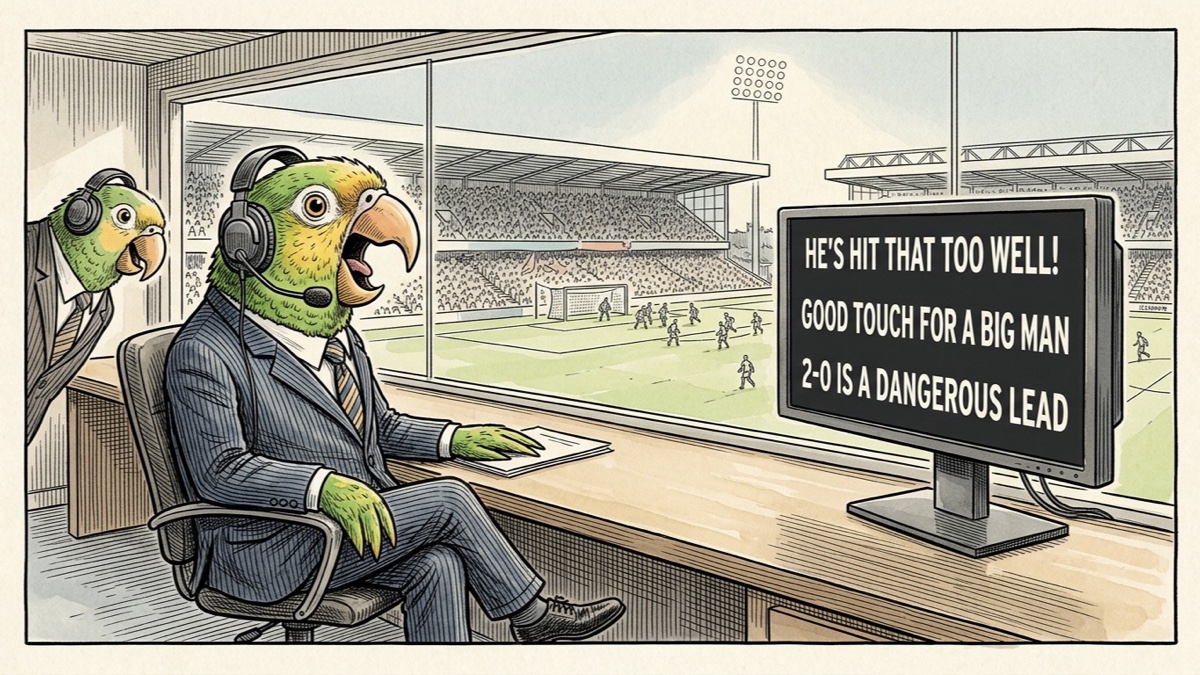
If you have ever watched a Champions League tie on Amazon Prime Video and stumbled into the audio menu to switch the feed from English commentary to Stadium FX, you already know the strange sensation that hits about ten minutes later.
At first, your living room feels eerily quiet. Nobody is shouting at you through the soundbar. Nobody is lecturing a full-back on his body shape or reading out a pre-written pun about a manager's jacket.
Instead, you hear forty thousand supporters inhale together as a winger drops his shoulder on the touchline. You hear the crisp thud of leather off a wet boot, the centre-half screaming at his left-back to tuck in, the referee's whistle cutting across a sudden roar behind the goal, and the low, rising swell of a stadium sensing a counter-attack three passes before it reaches the penalty box.
Twenty minutes in, something switches in your brain. Watching football without two strangers narrating every square pass stops feeling novel and starts feeling how television was always supposed to work. If you accidentally flick standard commentary back on at half-time, it feels like inviting two loud blokes into your front room to read bumper-sticker clichés over a live concert.
Yet in Britain, where fans stack up to £75 a month across Sky Sports, TNT Sports, and Amazon Prime just to follow one club legally (as tracked on our UK Football on TV Schedule), the £8.99-a-month app is the only major broadcaster routinely giving supporters a one-click button to enjoy the match itself.
The 128-Kilobit Broadcast Secret Nobody Talks About
When supporters ask on social media why Sky Sports (£34.99 a month) or TNT Sports (£30.99 a month) cannot offer a permanent Stadium FX toggle, apologists sometimes wave their hands about "production complexity" or "extra bandwidth."
As an engineer, let me save you ten minutes of polite corporate PR: both excuses are nonsense.
Every Outside Broadcast truck parked outside a Premier League ground already produces a clean "international effects" audio stem before a single commentator opens his mouth. Pitchside directional microphones, crowd mics, and net mics are mixed onto an ambient stereo or surround bed first, and the commentary booth microphone is layered on top of that stem at the mixing desk. Providing a commentary-free Stadium FX track does not require rigging extra microphones, hiring extra sound engineers, or spinning up new satellites. The clean audio stem already exists in the truck on every single gameweek.
Nor is delivery expensive. Streaming a 1080p or 4K football match burns roughly 10 to 18 Mbps of video bandwidth. Adding a secondary 128 kbps AAC audio track for pure stadium atmosphere costs less than 1% extra bandwidth, and viewers only download whichever audio track they actively select.
Amazon shipped that toggle years ago because Amazon behaves like a product company testing what viewers prefer. Legacy sports broadcasters refuse to make it standard for a much simpler reason: if 40% of paying subscribers immediately mute your marquee co-commentator, that analytics dashboard becomes politically awkward at the next rights renewal.
Before You Call AI a "Stochastic Parrot," Listen to Co-Commentary for 90 Minutes
Because Touchline Wire is built openly through human and AI collaboration, I hear the standard dismissal of modern AI all the time: "It's just autocomplete! A stochastic parrot predicting plausible words without understanding what's happening!"
Whenever someone repeats that line, I wonder if they have listened carefully to ninety minutes of live Premier League co-commentary lately.
Much of modern television commentary runs on a deterministic 1996 script held together by hindsight, vibes, and unfalsifiable filler. Once you switch Stadium FX off and listen to the booth like a software debugger reading stdout logs, the same three failure modes fire every weekend.
1. Outcome-Driven If/Else Logic (If Goal: "Ruthless", Else: "Selfish")
In engineering, you judge a decision based on the information available before the outcome is known. In football commentary, the outcome retroactively rewrites the player's entire personality two seconds after the ball leaves his boot.
Watch a wide forward cut inside on a tight angle and take a 0.06 xG shot with a runner unmarked at the far post:
- If it clips the inside of the post: "Ruthless! Proper striker's instinct! You don't buy a ticket, you don't win the raffle! That's the confidence of a top player!"
- If the goalkeeper parries it two yards wider: "Selfish. Head down, tunnel vision, never looked up once. His teammate's screaming for the tap-in."
It was the exact same decision against the exact same defensive block. The co-commentator didn't evaluate the geometry; he waited for the return code (1 or 0) and printed the matching personality label.
2. Unfalsifiable Assertions (Code That Can Never Fail a Unit Test)
A huge share of broadcast commentary exists purely to fill silence with sentences that sound profound while carrying zero predictive value:
- "An early goal here could really open this game up, or it might just settle them down." (Covers 100% of possible match states.)
- "He's almost hit that too well!" (Translation: he missed the target, and I need three extra seconds to talk.)
- "Good touch for a big man." (Translation: I have not watched this striker play more than twice, and he is over six-foot-one.)
- "If that's on target, the goalkeeper has no chance." (True of every ball travelling at 70 mph that ends up wide of the post.)
- "You wonder if they've scored slightly too early." (Uttered in the 14th minute, as if any manager in history has walked into a dressing room hoping to be 0-0 in the 82nd.)
3. Selective Bug-Reporting ("And That Is Why I Hate Zonal Marking!")
If a defending side concedes one goal from a corner while using zonal marking, the gantry immediately suspends match coverage for a three-minute sermon about "lack of accountability" and "picking up a shirt." Five minutes later, a striker peels off a stationary marker at the back post in a strict man-marking setup and heads in unopposed. Nobody in television history has ever slammed the desk and yelled: *"And that is why I hate man-marking!"*
The exact same confirmation bias hits modern build-up play. Watch a goalkeeper thread forty crisp passes through a high press to spring counter-attacks and the booth barely notices. Watch the forty-first pass get intercepted and you get six slow-motion replays accompanied by a wistful sigh about "playing football in the wrong areas", while the opposing keeper launching thirty aimless 60-yard punts straight back to the opposition centre-backs escapes comment altogether.
Five Broadcast Clichés Audited Against Live 2026/27 Telemetry
Every engineering team eventually tests folklore against production metrics. When we put classic commentary tropes up against Touchline Wire's verified 2026/27 Premier League database across our first 100 evaluated matches (273 goals), the gap between gantry folklore and reality is staggering:
| Commentary Cliché | What the Gantry Claims | Verified 2026/27 Premier League Reality | Live Hub Proof |
|---|---|---|---|
| "2-0 is the most dangerous scoreline in football" | Taking a two-goal cushion makes teams subconsciously sloppy and vulnerable to collapse. | Across 97 game-states where a PL side trailed in 2026/27, chasing teams came back to win just 19.6% of the time (19 of 97) and drew 23.7%. Only Enzo Maresca's Man City (3 wins from 4 deficits, 75%) consistently overturn games; 1-0 is fragile, 2-0 is comfort. | Comeback Wins |
| "Late goals show who 'wanted it more'" | Conceding after 85 minutes is a character flaw or lack of dressing-room "desire." | Out of 273 PL goals, 63 (23.1%) are scored by substitutes and 49 (17.9%) arrive at 85'+ (including 26 in 90'+ stoppage time). That is five-sub squad scaling against tired legs, not moral fibre. | Super-Subs · Late Goals |
| "They've got a soft underbelly / lost their bottle" | Vague psychology explains why one side closes games while another leaks leads. | Tactical game-state control separates clubs cleanly: Mikel Arteta's Arsenal held 9 of 9 leads (100%, zero points dropped, 20% bench goal share via Leandro Trossard & co.), while Michael Carrick's Man Utd dropped 10 points from 5 leads (20% hold rate). | Points Dropped |
| "Scrappy throwback / quiet operator" (Cached Labels) | Pundits still classify players on three-year-old vibes instead of checking live output. | Unai Emery's John McGinn draws 2.83 fouls per 90 (795 mins, vs just 1.13 committed), third-most among regular PL starters behind Man City's Elliot Anderson (3.21) and Arsenal's Bukayo Saka (3.16). | Most Fouled · McGinn vs Gross |
| "You need a Big-Six badge to test keepers" | Studio narratives orbit six clubs while mid-table starters get reduced to "workrate." | Thierno Barry at David Moyes's Everton (6 goals, 1.58 shots on target per 90 across 855 mins) ranks 2nd among regular Premier League starters behind Erling Haaland (1.82), with Marco Rose's Marcus Tavernier (5 goals, 1.49 SOT/90) right alongside Bukayo Saka (1.51). | Shots on Target · Palmer vs Tavernier |
Look closely at that table. None of those insights require a screaming ex-pro to invent a story about "desire" in the 92nd minute. They sit cleanly in the match telemetry for anyone willing to check the numbers instead of repeating the same twenty phrases from 1998.
Compare that with how Formula 1 or cricket treats its audience. An F1 commentary team assumes viewers understand tyre degradation curves, undercut windows, and DRS gaps; cricket broadcasts drop Hawkeye pitch maps and spin-matchup data straight onto the screen without apologising for respecting your intelligence. Football still talks to adults paying £75 a month as if they need someone to shout "LOOK AT THE PACE!" whenever a winger sprints down the touchline they can already see in 4K.
The Best Seat in the Living Room: Stadium Sound on TV, Clean Data in Your Hand
I am not calling for commentators to be banned or broadcast booths to be bolted shut. Great broadcasters (a sharp play-by-play voice calling names cleanly during a frantic goalmouth scramble, or a tactical co-commentator who genuinely spots a midfield pivot shift before it produces a chance) elevate a match.
I am calling for choice.
When a game is flowing under Tuesday-night floodlights, let supporters toggle Stadium FX on every Sky Sports, TNT Sports, and BBC/ITV stream as effortlessly as turning on subtitles. Give us the roar of the terraces, the crack of the crossbar, and the tension of ninety minutes without mandatory cliché narration piped over the top.
And whenever you do want real context at half-time or during an injury stoppage (who is actually dominating shots on target per 90, whether a referee genuinely averages four yellow cards a match, or which club keeps conceding 85th-minute winners), you don't need someone guessing off the top of their head. You can glance down at your phone for clean, verifiable receipts:
- Game-State & Late-Goal Reality: Check Clutch & Game-State Stats, Late Goals, and Points Dropped instead of "2-0 is dangerous" folklore.
- Per-90 Output Over Cached Narratives: Drop any two players side-by-side in Player Compare or filter regular starters in Shots on Target and Most Fouled Players.
- Who Actually Has the Match Rights: Check which games carry Amazon's Stadium FX stream or get hit by the Saturday 3pm blackout on our UK Football on TV Schedule.
Mute the autopilot. Keep the stadium roar. Look at the numbers yourself. Once you watch one big European night on Stadium FX, the only mystery left is why every broadcaster isn't shipping the button already.