AI-Augmented ‘Opinionism’ • Founder's Notebook • Data-Driven • AI-Assisted • Human-Guided
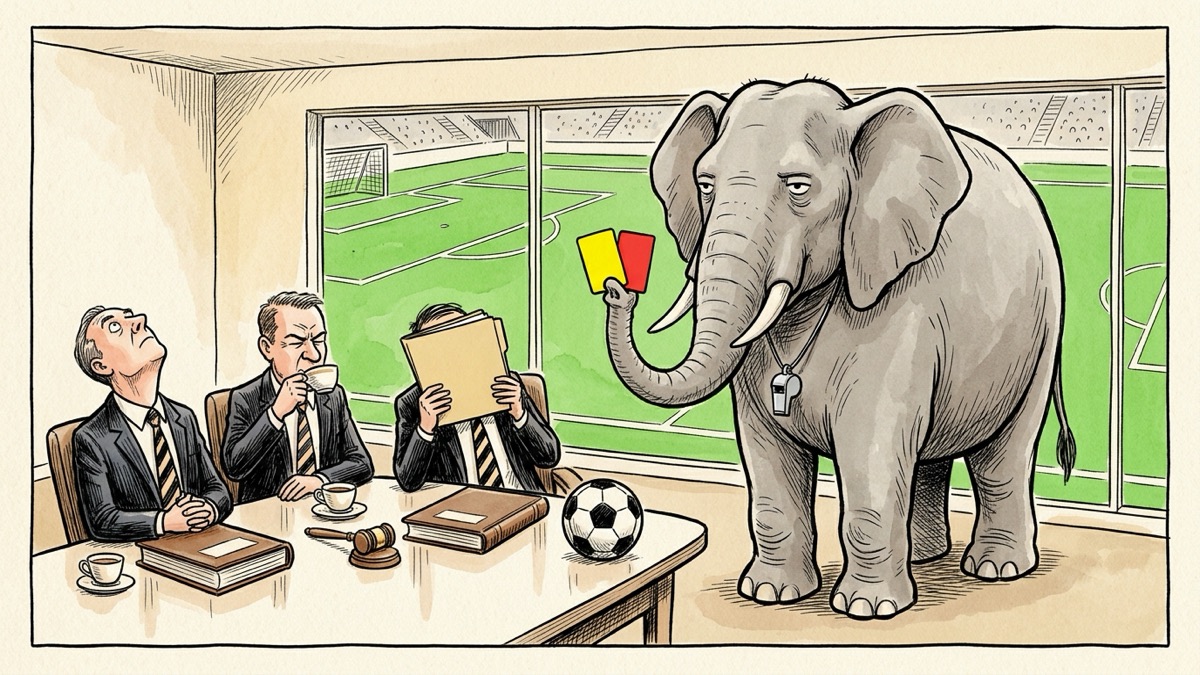
The Officiating Elephant in the Room
A techie and football fan's look at human error and unconscious bias, title races swung by officiating mistakes, why 90% of punditry misses the point, and how technology can return the sport to pure skill.
Rob Ross - Founder • Originally published • 19 min read • 4247 words
Editorial Point-in-Time Snapshot: Figures cited in essay prose reflect Touchline Wire telemetry on the publication date above; follow the live data links below for real-time updates.
In February 2022, Rodri controlled a bouncing ball with his arm inside his own penalty area at Goodison Park; the referee missed it, VAR waved it through, PGMOL phoned Everton three days later to apologise, and Manchester City went on to win the Premier League title ahead of Liverpool by a single point.
A year later at the Emirates, title-chasing Arsenal dropped two vital points to Brentford because the technology was sitting right there on screen and VAR Lee Mason literally forgot to draw the offside lines.
And in October 2024, VAR talked the on-field referee into awarding West Ham a phantom stoppage-time penalty against Manchester United; Erik ten Hag was sacked the next morning, and days later PGMOL chief Howard Webb went on television to admit it should never have been a foul.
"Just Part of the Game" Just Isn't Good Enough
I build software for a living, and if a system I worked on failed that badly and caused catastrophic knock-on effects on that scale, nobody would accept a polite apology after the damage was done and run the exact same broken process again on Saturday. You would fix the architecture.
Yet in an £8-billion sport obsessed with marginal gains, we still allow human error and unconscious bias to decide who wins titles, who gets relegated, and who loses their job, and tell ourselves it's all "just part of the game."
Listen to what the word "just" is doing in that sentence. People reach for "just" whenever they want to shrink a serious problem until nobody feels obliged to fix it: "it's just one of those things," "referees are just human," "it's just part of the drama." Put "just" in front of a failure often enough and a ruined season starts sounding like bad weather rather than something anyone could have prevented.
And if you think those opening examples were isolated incidents, they barely scratch the surface. At Stamford Bridge in August 2022, Cristian Romero dragged Chelsea's Marc Cucurella to the turf by his hair moments before Harry Kane's 96th-minute equaliser; a year later, VAR Mike Dean openly admitted on a podcast that he didn't send referee Anthony Taylor to the monitor because Taylor was "a mate" and he wanted to spare him "any more grief."
Barely five weeks after that podcast confession came Luis Díaz at Tottenham, a completely legal goal wiped out by two words ("check complete") and a booth full of officials frozen behind protocol muttering "can't do anything."
Fast-forward to this 2026/27 campaign and nothing has fundamentally changed. The Premier League's own Key Match Incidents panel has already voted 5–0 that Erling Haaland's goal in September's Manchester derby should never have stood.
Then in November, Alexander Isak had his shirt hauled back inside the box against Arsenal, got nothing because he fought to stay on his feet instead of diving, and watched the independent Key Match Incidents panel admit days later that both the referee and VAR got it wrong and Liverpool should have had a penalty.
Arsenal won that game 1–0 to stretch their lead over Liverpool to nine points. Had that penalty been awarded, scored, and turned the game around, Liverpool could have closed the gap to three instead: a potential six-point swing in the title race from one missed call.
Whenever decisions like these happen, social media immediately jumps to corruption or a secret agenda against a particular club, and I don't buy that for a second. Honestly, deliberate bias would almost be easier to solve, because you could just sack the bad actors.
What we are actually watching every weekend is much more mundane and impossible to train out of people: plain human error compounded by unconscious biases.
On the error side, you have honest officials running at sprint speed, with obstructed sightlines and a heart rate north of 150 bpm, trying to judge millisecond contact in real time, backed up by a VAR room still capable of forgetting to draw offside lines or misreading what was called on the pitch.
On the bias side, 60,000 home fans roaring for a foul inevitably sways a 50/50 whistle, something data analysts proved beyond doubt when away-team bookings dropped sharply inside empty stadiums during lockdown.
Reputation creeps in too: certain forwards earn a soft free-kick on name value while defenders with a disciplinary history get booked on reputation, and honest strikers get punished for staying upright because referees subconsciously rely on a "no fall, no foul" shortcut.
Layer on the natural human instinct to defend your first guess, plus a VAR official reluctant to humiliate a colleague on live television under a vague "clear and obvious" bar, and you don't have a conspiracy. You have a system built entirely on human flaws.
The Receipts: When "It Evens Out Over 38 Games" Literally Flips League Titles
We constantly get told that bad decisions "even themselves out over a season." Look at how many recent Premier League and European title races - and relegation battles - were settled by 1 to 3 points, alongside single high-profile officiating mistakes in head-to-head or decisive matches:
| Season | Competition | Final Margin | Decisive Match & Verified Incident | Potential Points Swing | Verified Source |
|---|---|---|---|---|---|
| 2021/22 | Premier League | 1 pt (Man City 93 – Liverpool 92) | Everton 0–1 Man City (26 Feb 2022, 85'): Rodri clearly controlled the ball with his arm inside the box at 0–1. Missed by Paul Tierney & cleared by VAR Chris Kavanagh. PGMOL chief Mike Riley personally phoned Everton to apologise. | -2 pts to Man City (if 1–1) → Liverpool win title (92 vs 91) | The Guardian - Mike Riley apologises to Everton |
| 2023/24 | Premier League | 2 pts (Man City 91 – Arsenal 89) | Liverpool 1–1 Man City (10 Mar 2024, 98'): Jérémy Doku planted his studs chest-high into Alexis Mac Allister inside the penalty area; waved away by Michael Oliver & VAR Stuart Attwell.<br>Newcastle 1–0 Arsenal (4 Nov 2023): KMI Panel later judged (3–2) Bruno Guimarães should have seen red.<br>Tottenham 2–1 Liverpool (30 Sept 2023): Luis Díaz's legitimate onside goal disallowed after VAR Darren England's "check complete" error ("significant human error" admitted by PGMOL). | 2-point final gap; single penalties/red-card points swings decide the championship (91 vs 89) | Goal - Doku / Mac Allister 98' VAR · Goal - Newcastle vs Arsenal KMI Panel · The Guardian - Luis Díaz PGMOL error |
| 2018/19 | Premier League | 1 pt (Man City 98 – Liverpool 97) | Man City 2–1 Liverpool (3 Jan 2019 - Liverpool's only defeat all season): Vincent Kompany's studs-up lunge on Mohamed Salah at 0–0 (31') drew only a yellow card from Anthony Taylor (same night Goal-Line Tech calmly measured 11mm with zero debate).<br>Liverpool 1–1 Leicester City (30 Jan 2019): Ricardo Pereira tripped Naby Keïta in the box at 1–1; waved away by Martin Atkinson. | +2 pts in a 1-point race (alongside City's own 1–1 at Wolves via Willy Boly's handball - proving human noise cuts randomly everywhere) | The Guardian - Klopp frustrated after Leicester draw |
| 2013/14 | Premier League | 2 pts (Man City 86 – Liverpool 84) | Man City 2–1 Liverpool (26 Dec 2013): At 0–0, Raheem Sterling ran clean through onto Luis Suárez's pass to round Joe Hart and score, only to be flagged offside by assistant Stuart Burt despite grass stripes showing him onside by nearly two yards. | Even a 2–2 draw is a 3-point title swing (City 86 → 84, Liverpool 84 → 85) | The Guardian - Man City 2–1 Liverpool match report |
| 2009/10 | Premier League | 1 pt (Chelsea 86 – Man Utd 85) | Man Utd 1–2 Chelsea (3 Apr 2010, Matchweek 33 title decider): Didier Drogba scored Chelsea's decisive second goal on 79' (0–2) while standing a full yard offside before Federico Macheda pulled one back on 81' (referee Mike Dean, assistant Darren Cann). | 1–1 draw creates a 3-point net swing (Chelsea 86 → 84, Man Utd 85 → 86) | Sky Sports - Man Utd 1–2 Chelsea report |
| 2019/20 | Premier League Survival | 1 pt (Aston Villa 35 – Bournemouth 34) | Aston Villa 0–0 Sheffield United (17 Jun 2020, 42'): Villa keeper Ørjan Nyland carried Ollie Norwood's free kick behind the line. Hawk-Eye cameras were occluded and VAR Paul Tierney failed to step in. | Single point (35 vs 34) decided a £100m+ relegation battle | The Guardian - Hawk-Eye apologises for Villa Park error |
| 2013/14 | La Liga | Winner-Takes-All Final Day (Atlético 90 – Barça 87) | Barcelona 1–1 Atlético Madrid (17 May 2014, Matchweek 38): Needing a win for the title, Lionel Messi scored in the 64' minute; Antonio Mateu Lahoz disallowed it for offside thinking it came off Cesc Fàbregas when it deflected off Atlético defender Juanfran. Mateu Lahoz apologised to Barcelona's staff afterward. | Directly reversed who lifted the La Liga trophy on the final afternoon | The Guardian - La Liga title decider · Mundo Deportivo - Mateu Lahoz apology |
| 2016/17 & 2011/12 | La Liga / Serie A | 3 pts / 4 pts | Real Betis 1–1 Barcelona (Jan 2017, La Liga 93 vs 90): Ball crossed line by ~half a metre with no GLT.<br>AC Milan 1–1 Juventus (Feb 2012, Serie A 84 vs 80): Sulley Muntari header clawed back a metre past the line at 1–0 up. | Two classic "ghost goals" inside 3–4 point title races before line tech | The Guardian - Betis 1–1 Barcelona ghost goal · The Guardian - Muntari ghost goal |
These examples should put to bed the lazy cliché that bad decisions "even themselves out over 38 games." Anyone who works with data knows 38 matches is nowhere near a big enough sample size for random errors to cancel out, especially when five modern Premier League title races have been settled by just one or two points.
When margins are that thin, a single mistake in a six-pointer doesn't magically balance out by May. It decides who lifts the trophy.
Think of Didier Drogba standing a yard offside at Old Trafford in 2010, Raheem Sterling flagged offside with two yards of daylight on Boxing Day 2013, Jérémy Doku's 98th-minute studs into Alexis Mac Allister's chest in 2024, or Lionel Messi having a final-day La Liga title-winner chalked off in error.
Worse still, calls like those rewrite football history, branding brilliant players and managers as "nearly men" over a one-point gap that came down to an official's mistake rather than anything on the pitch.
Compare that to January 2019 at the Etihad, when John Stones hooked the ball off the line with 11 millimetres to spare: Goal-Line Technology measured it instantly and nobody argued for a second, proving that when football actually trusts proper engineering, the controversy disappears overnight.
The Butterfly Effect: £7m Matchdays, National Mental Health & Whole-City Economies
A wrong call doesn't end when the referee blows full time. From an individual supporter's Monday morning to an entire city's hospitality industry, one bad whistle carries massive downstream consequences:
- 60,000 Supporters & a £6m–£9m Collective Matchday Spend: Take a modern 60,000-seater Premier League stadium. Once you add a match ticket (£60–£80+), train/fuel/parking (£30–£60+, often steeper when matches get shifted for TV or involve long away trips), a pre-match pub pint (£5.50–£6.95), and concourse food/programmes (£15–£25), the average supporter is easily spending £100–£150+ out of post-tax wages just to be there.
Multiply that across 60,000 people and you're looking at £6 million to £9 million of ordinary fans' hard-earned money poured into a single afternoon - only for one preventable guess or unconscious bias to break their week. And while you might say, it's part of the experience. Of course it is. But is it part of the experience to have the outcome of the game decided by a poor decision that could have been avoided? Or would we all prefer the outcome be decided by the players on the pitch?
- National Mental Health & World Cup Scars (Plus Proof Outrage Forces Change):
- Diego Maradona's "Hand of God" (Argentina 2–1 England, 22 June 1986 World Cup Quarter-Final): Missed in the 51st minute by referee Ali Bin Nasser and linesman Bogdan Dochev. It haunted English football for forty years - and poisoned both officials' lives so deeply that they publicly blamed each other and never spoke again (The Guardian - Maradona 'Hand of God' referees' feud).
- Frank Lampard's Ghost Goal vs Germany (Germany 4–1 England, 27 June 2010 World Cup Round of 16, Bloemfontein): Yes - at 2–1 (38'), Lampard's strike hit the bar and bounced roughly half a metre behind Manuel Neuer's goal line before being waved play-on by referee Jorge Larrionda and assistant Mauricio Espinosa, gutting an entire country's World Cup summer. Crucially, it also created a positive butterfly effect: within 48 hours, the global embarrassment forced FIFA president Sepp Blatter to apologise to the FA and reopen the door to Goal-Line Technology (The Guardian - Sepp Blatter apologises & reopens goal-line tech).
- Thierry Henry's Handball vs Republic of Ireland (Nov 2009 World Cup Play-Off): An extra-time double-handle denied a nation of five million people a place in South Africa - and FIFA quietly paid the FAI €5 million (£3.67m) to settle legal threats (The Guardian - FAI publishes proof of €5m FIFA payout).
- Whole-City Economies - Cancelled Trophy Parades & 1-Point Relegation Redundancies:
- The Missing Title Parade (93 vs 92 or 98 vs 97): A Premier League victory parade in a football city like Liverpool draws 750,000 to 1.2 million visitors, filling hotels, pubs, restaurants, and trains across a regional visitor economy supporting ~60,000 hospitality and tourism jobs (Liverpool Chamber - Parade weekend hospitality surge). In a 1-point title race, one ungiven handball in February doesn't just move a medal - it can erase a multi-million-pound weekend windfall for small local businesses in May.
- 1-Point Relegation Fallout (35 vs 34): When a club goes down by a single point after a missed ghost goal (like Bournemouth in 2019/20), the £100m+ Premier League revenue cliff rarely hurts the millionaire players on the pitch - it hits club shop staff, stewards, caterers, community trusts, and high-street businesses around the ground.
When supporters invest that much money, emotion, and Monday-morning mental health into following their club, hearing pundits in a television studio shrug off a bad call with "you win some, you lose some" rings pretty hollow.
It is easy to be philosophical when you walked in on a press pass and a refereeing blunder just handed you ten minutes of easy television. Try telling that to the away fan stood on a freezing station platform at 10pm after spending £140 they budgeted all month for, or the club stewards and catering staff facing job cuts after a one-point relegation.
Players still collect their wages and move clubs, and officials get rotated out for a weekend; it is always ordinary supporters and local communities who end up paying the real price.
Yet every time someone suggests taking more decisions out of human hands, traditionalists wheel out the same tired line that mistakes are part of football's "romance" and give us something to argue about down the pub.
Nobody sat in a pub after Frank Lampard's ghost goal against Germany in 2010 thinking how lucky we were not to have Goal-Line Technology because of the great conversation it sparked. Everyone knew immediately it was a farce. The romance of football comes from a 30-yard screamer, a tactical masterclass, or a lower-league giant-killing, never from an official guessing wrong.
Bad VAR, Obvious Errors & The "Clear and Obvious" Trap
Even after VAR was introduced specifically to stop "clear and obvious" blunders, human execution kept inventing brand-new failure modes:
- Forgetting the basics in the VAR hub: In February 2023 (Arsenal 1–1 Brentford), VAR official Lee Mason forgot to draw the offside lines on Christian Nørgaard's assist for Ivan Toney before departing PGMOL by mutual consent days later (The Guardian). Seven months later, Darren England and Dan Cook saw Luis Díaz was onside against Spurs, accidentally thought the on-field call was "goal," and said "check complete" - and protocol barred them from stopping play seconds later (The Guardian).
- And in the current 2026/27 season, the exact same structural bugs are still happening:
- GW9 (Liverpool 0–1 Arsenal, 1 Nov 2026): Jurriën Timber grabbed a sustained handful of Alexander Isak's shirt inside the penalty area; waved away on-field by Andy Madley and left untouched by VAR Stuart Attwell because Isak fought to stay on his feet instead of diving - before the Premier League's Key Match Incidents panel ruled 4–1 that a penalty should have been given and 3–2 that VAR was wrong not to intervene (Sky Sports).
- GW7 (Newcastle vs Aston Villa): The KMI Panel managed to vote 4–1 that failing to show Sven Botman a direct red card was wrong, yet 3–2 that VAR was correct not to intervene.
- GW4 (Man Utd 0–1 Man City, 13 Sept 2026): Unanimous 5–0 KMI ruling that VAR Matt Donohue missed Enzo Fernández's offside interference on Erling Haaland's 60th-minute winner after overturning the initial offside flag - followed by zero rollback of the points.
Read that Newcastle against Aston Villa verdict back twice, because it sums up everything broken about Premier League officiating in a single sentence: the league's own panel agreed the referee got a game-changing red card wrong, and simultaneously agreed that the video official was right to sit there and do nothing about it.
Imagine writing an error-checking layer in software that spots a faulty output and waves it straight through to live users anyway because the bug wasn't "clear and obvious" enough.
This doesn't feel like a system designed to make sure decisions are right; it feels like PR and damage limitation for the officials on the pitch when they make mistakes. Stockley Park ends up hunting for any plausible excuse to stand behind a colleague's first guess rather than simply correcting it.
Then Monday rolls around, the Key Match Incidents panel logs another post-mortem admitting a club was short-changed with zero points returned, and frustrated voices demand we scrap VAR altogether, blaming the cameras rather than the broken human rules governing them.
The 90% Punditry Tax: Watching Courtroom Drama Instead of Football
Watch the after-match reaction to almost any big Premier League game now and it feels like ninety per cent of the coverage has little to do with football.
Instead of breaking down how a manager tweaked his press at half-time, how a midfielder ran the game, or how a winger beat his full-back in a yard of space, we get twenty minutes of ex-pros dissecting slow-motion replays and playing courtroom barrister.
Every weekend brings another forensic argument over sleeve lines, "unnatural silhouettes," "subjective offside," and whether a tackle was "an orange card." Broadcasters now keep retired referees on standby in the studio just to translate Pro Ref's (the rebranded PGMOL's) latest directive in real time, which tells you everything about how badly officiating has hijacked the spectacle.
We want Match of the Day and post-match punditry to be about tactics and skill. We don't want the discussion being dominated by controversial calls.
That obsession bleeds straight into supporter culture too. Rather than talking about the football on Monday morning, rival fans spend half the week trading freeze-frame screenshots from three months ago to prove a particular official has an agenda against their club.
Part of the problem is that broadcasters and phone-in shows quietly love the chaos because outrage drives clicks and engagement far more reliably than a tactical breakdown ever could. Nobody buys a ticket or pays for a TV subscription to watch the referee, yet every single weekend the officials end up as the main characters.
Same Rules, Different Referee: What the Data Shows
You don't even need a headline VAR meltdown to see the problem; it is sitting right there in the everyday numbers. When I put together the Referee Strictness Dossiers here on Touchline Wire, what jumped out immediately was that Premier League officials genuinely have measurable "personalities" and traits.
In our 2026/27 data alone, yellow-card rates swing by more than 30 per cent depending on who gets the whistle, from Sam Barrott and Peter Bankes averaging 4.5 bookings a game down to Simon Hooper on 3.44, who tends to keep his cards in his pocket for the opening 25 minutes and wave physical contact on.
Even wilder, Anthony Taylor awards 0.38 penalties per match while Craig Pawson sits at 0.14, meaning you are nearly three times more likely to see a spot-kick with one official than another.
Clubs and pundits talk casually about how one referee "likes to let it flow," another "books early to stamp his authority," and Peter Bankes dishes out over 70 per cent of his bookings after half-time.
How on earth is that an objective way to officiate elite sport? Ten grounds supposedly play under the exact same rulebook on a weekend, yet what counts as a foul or a penalty effectively changes on Tuesday afternoon when the referee appointments are announced.
This isn't pro wrestling, where the referee is meant to be a character in the ring with his own signature style. The simple fact that referee personality profiles exist and actually help predict matches tells you how much subjectivity is baked into every whistle.
Re-Architecting the Whistle: From AI-Backed Jury Panels to Crest-Blind Autonomous Officiating
We already have living proof inside the same matches that technology kills controversy when it is deterministic:
- Goal-Line Technology (11mm): Nobody spent five years arguing about John Stones's clearance in Man City vs Liverpool (Jan 2019), because sensors returned an instant, crest-blind millimeter measurement. Contrast that with Kompany's lunge in the exact same match - pure human opinion, argued over forever.
- Semi-Automated Offsides: Once optical skeleton tracking replaces dragging manual crosshairs over TV broadcast frames, "forgot to draw the lines" disappears as a failure class.
If we rebuilt football's officiating from scratch today as engineers, we wouldn't tweak VAR's wording - we'd redesign the decision architecture. Here are five concrete models, ranging from pragmatic immediate fixes to full AI-first systems:
- Captain's Challenge + Rugby/Cricket Live-Mic Transparency: Give each manager or captain two challenges per match (kept if successful), broadcast the check and live referee/VAR reasoning to fans in the ground and on TV like rugby/cricket, and scrap the absurd protocol rule where restarting play makes an admitted factual mistake irreversible five seconds later.
- On-Pitch Human Proxy + Isolated AI-Assisted Jury Panel: Keep one calm human official on the pitch purely as a match-flow and player-management proxy, while contentious incidents go to an off-site 3- or 5-person specialist jury sitting in isolated booths. Voting blindly without talking to each other (no groupthink, no deferring to a senior mate's original whistle) within under 10 seconds - assisted by instant AI-selected angles, contact timestamps, and shirt-pull telemetry - breaks Stockley Park's "clear and obvious" mate-protection loop.
- "Crest-Blind" Anonymized 3D Avatar Review: Instead of showing the jury TV footage filled with screaming crowds, famous faces, and red or sky-blue shirts, feed reviewers neutral grey 3D skeletal meshes (Team A vs Team B) in silence. If reviewers literally cannot see kit colours, club crests, reputation, or match minute, unconscious club bias becomes impossible.
- Fully Automated Multi-Model "AI Panel" (Ensemble Consensus): Combine 500Hz ball sensors and 3D optical tracking (100% deterministic for offsides, corners, handballs, and goal-lines) with an ensemble of independent computer-vision foul models measuring collision trajectories, stud exposure, and jersey stretch (centimetres displaced). Honest attackers like Alexander Isak get penalties without having to dive, while theatrical zero-contact dives get booked automatically.
- Hybrid Fail-Safe (AI-First + Blinded Jury Fallback): Let the automated AI system resolve 95%+ of binary and high-confidence calls straight to the pitch proxy's watch/earpiece in under 2 seconds, and route only low-confidence boundary cases - or camera-occlusion events like Villa Park 2020 - to the anonymized human jury so neither tech blind spots nor human fatigue decide games alone.
I am not pretending I have all the answers here. Every one of those models comes with trade-offs, and any new setup would have rough edges at first before getting refined.
What football desperately needs is a serious, grown-up discussion and a genuine openness to reform, rather than endless summer tweaks to the same broken VAR handbook.
Whenever you improve a complex system in any other industry, you trial ideas in smaller competitions or early cup rounds, measure what speeds up accuracy, and bin whatever drags the game down. Right now, Pro Ref (formerly PGMOL, rebranded ahead of 2026/27 without fixing the underlying architecture) and lawmakers won't even open that door, treating one exhausted referee backed up by a colleague in a video booth as untouchable while the root problem remains ignored.
Whether football eventually lands on rugby-style live mics, an isolated crest-blind jury, or AI models working quietly in the background, standing still clearly isn't working.
Nobody wants technology to strip the emotion, unpredictability, or human spirit out of the players on the grass. Quite the opposite: taking preventable human error and unconscious bias out of the officiating is the best way to make sure the result belongs to the skill, bravery, and tactics we all actually came to watch.